Stranded on a Bridge
In the latest edition of “On the Rise With Fly,” how Hurricane Katrina stirred an awakening.
In 2005, a massive hurricane descended on the city of New Orleans, Louisiana, breaking the levees and flooding the city. Hundreds, if not thousands, of New Orleanians died, and thousands more were stranded on roofs, in cars, on top of bridges.
This tragic phenomenon has had a powerful impact on my life. I remember faithfully watching the CNN news coverage of the horrific event. There were dead bodies floating in the floodwaters, flowing down the streets of New Orleans. The strangest thing is that I only remember seeing Black people crying for help, holding SOS signs, and trying to get someone to rescue them from sudden death.
I want to direct your attention to one scene, where hundreds of civilians were stranded on a bridge. This event went on for three days.
After the first day, I was hopeful that the U.S. government would render aid. NO SHOW! Then on day two, I knew that aid would come. But still, NO SHOW! Day after day, I saw the same individuals walking back and forth on that same bridge, and still no assistance from the government.
Where on earth was the United States government? In one of the richest nations in the world, one of its cities was underwater and looked like a developing country. Why hasn't the government sent aid to these people after 48 hours without food or water?
I observed people who looked like me, who appeared to go through the same hardships in life as I did. Most of all, I saw what appeared to be drug addicts and crack babies running up and down the bridge, after two days without a change of Pampers. Why would these people be left to fend for themselves? What type of government would do this to its citizens?
During the coverage, a news reporter on the CNN broadcast said, “President George W. Bush just flew over the scene in Air Force One.” Surely the president has now witnessed this atrocity firsthand and aid will be arriving swiftly. After several hours had passed, still NO SHOW!
I felt sad for those individuals trapped on that bridge, and although I'd never met them, I felt like they were my kin. I felt empathy from more than 700 miles away, in a prison cell at Menard Correctional Center.
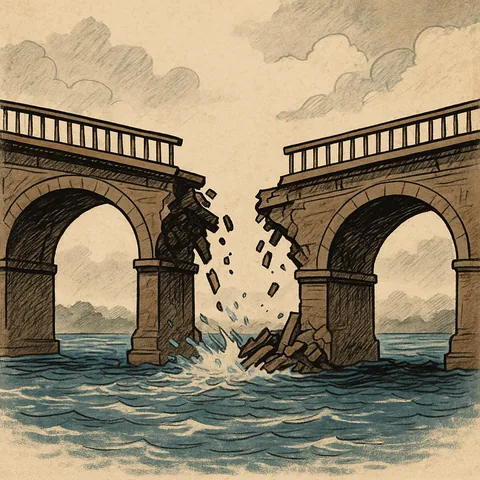
Five years prior, I had been arrested and sent to the Cook County Jail. I was young, immature, and unruly. I did not really care about anyone, let alone care about building bridges. I was a drug dealer, a gang-banger, and now a murderer. After several brawls, a few stints in segregation, and a guilty verdict, I was sentenced to 53 years in prison. The reality of a half-century sentence smacked me hard, like a bridge had collapsed under my feet, splashing down into the murky waters.
Before leaving the county jail, an inmate I knew, Squeak, had a revelation in a dream: “God told me that you would be found guilty of your crime, you’d do some time in prison, but that you’d go home, and be the leader of your people.”
A friend of mine, from before I got arrested, heard this and laughed really hard. “You'll lead them off a cliff,” he said. “You're too stupid to be a leader.” His comments and actions took me aback, but they lit a fire inside of me. I vowed that when I got free, I would be a good leader. I would not lead my people off a cliff, but over a bridge of prosperity.
The tragic event that took place in New Orleans made me reflect on the lives that I impacted in my neighborhood and along my journey of destructive behavior. How had I left so many of my people stranded, like President Bush did? I flew over them, leaving them on a bridge stranded somewhere between hope and despair.
Before I was arrested, I remember attending a neighborhood watch meeting to do reconnaissance. I listened to community members reveal a plot to stage a large-scale protest on the streets where we sold drugs. The following day, they began marching, holding anti-drug signs, chanting, “No more rocks [cocaine], no more blows [heroin], on this block no more.” The marching and chanting went on for days. The marchers were rescuing the neighborhood from the floodwaters of despair, building a bridge to a safer community.
All I had to do was pick up a sign and join the construction of that bridge. But due to my own immaturity and selfish reasoning, I mocked them, laughed at their efforts openly, and chose money over saving the community. That bridge was never built, and the people of the community remained stranded.
The scene on that fateful bridge in New Orleans compelled me to see all of the bridges I had burned, but most importantly, the people I had hurt. I was suddenly overcome by a moment of clarity. I needed to repair those bridges that I had once scorched.
Had I known better, I could have done better for my community. I could have built recreational centers for at-risk youth. I could have gone to school for journalism or started a nonprofit. I could have become an entrepreneur and hired people from the community, giving them jobs, not drugs.
I asked a question that would guide me for the years to come: How could I build a bridge of hope? Without tools, I couldn’t build anything, so I knew I needed to get myself an education.
I earned my GED in 2009. By 2015, I had written and completed my first novel, “Savage Beast.” Soon after, I earned an associate degree in theology, then joined NPEP, where I completed an associate degree from Oakton College, was named a Presidential Scholar, and was inducted into the Phi Theta Kappa honor society. I recently finished my Bachelor of Science degree with a major in social sciences from Northwestern University’s School of Professional Studies, and today I serve as a columnist for the Northwestern Insider.
Becoming a motivational speaker is one of my life's goals. It is the genesis of this column that has the goal of helping people, a bridge for all people to cross.
I did a lot of self-reflecting during those three days of horror for the New Orleanians suffering at the hands of nature and the U.S. government. Eventually, on the third day, help came for those hungry and dying of thirst on that bridge in southern Louisiana. But the damage was done: the government had exposed their hand and revealed it didn't give a damn about Black folks. It also showed me that neither did I.
Witnessing the devastating aftermath of Hurricane Katrina and the tragedy on that bridge of hopelessness, I questioned my soul. How could I not have given a damn about the community? I had loitered on their corners, sold drugs to their relatives, and robbed them of their goods. I was a nuisance, destroying the very fabric of any bridge-worthy institution — and any notion that I gave a damn.
After 19 years, I’ve kept my promise to change. I’m writing this in hopes of reaching others who have sold drugs or contributed to the harm of Black and Brown communities. We can’t wait for anyone else to fix what’s broken. If we don’t protect and rebuild our communities ourselves, no one will.
American jails are full, and they are filled with Black and Brown men and women who have left their families and friends in their communities, stranded on a bridge with no food or water. Stranded without any hope in sight. Stranded, waiting for the United States government to save them. The truth is, the government will not come.
We must start building bridges to rescue ourselves and our loved ones. We must do this by becoming good leaders, and showing the community what good leadership looks like.
- Writer
- Flynard “Fly” Miller
- First published
- Vol. 2, Issue 2 · 2025 · pp. 72–73
- Original edition
- Download the issue (PDF) (opens in a new tab)