In Conversation with ... Rachel Ventura, Illinois State Senator, 43rd District
Lynn Green — an NPEP graduate and one of the first incarcerated legislative interns in Illinois history — interviewed the state senator on her efforts in uplifting the incarcerated.
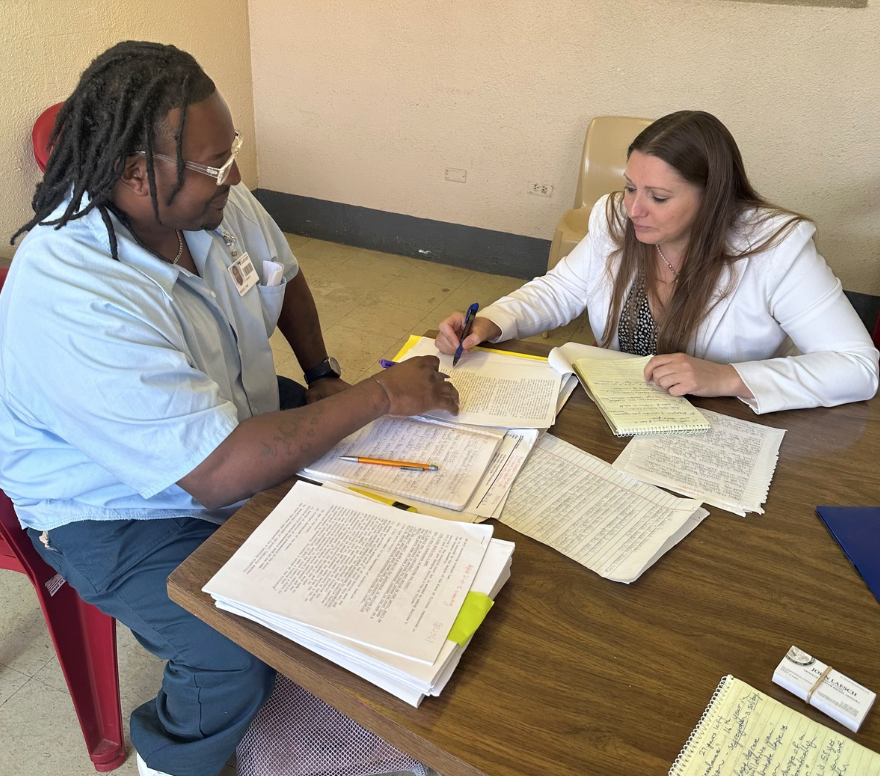
Courtesy of State Senator Rachel Ventura
In a cramped, musky chapel room in Stateville Correctional Center, a maximum-security prison, the DePaul Law & Policy Think Tank members stand behind red plastic seats to greet Senator Robert Peters and his guest, Rachel Ventura. It is a Thursday in the summer of 2022, a few months before the November election, and Ventura is running to capture the state senate seat for the 43rd District in Joliet, Illinois.
The DePaul Law & Policy Think Tank is the product of DePaul University’s Inside-Out Prison Exchange Program. In the Think Tank, students engage in critical thinking, challenging existing social policies, designing new policies, or improving policies that contribute to solving poverty, mass incarceration, and other social inequalities.
After introducing everyone in the room, our host, Dr. Christina Rivers, opens the floor. This is not Senator Peters’ first time visiting our think tank, so he gives a breakdown of what he would like to accomplish legislatively and a brief overview of things that are taking place surrounding the elections. Then he smiles as he knows what’s coming next: the barrage of questions from think tank members. And he’s right—the questions flow.
Soon, many questions are directed to Ventura. What are your beliefs and values? If you are elected, what kind of senator will you be?
Then, a question is asked that captures everyone’s attention: If elected, will you consider us, the incarcerated, as your constituents?
Without hesitation, she responded, “Yes.” Will you return to our think tank to speak with us on your own and work with us on policy? “Yes.”
Then, one of the members, Eric Watkins, puts Ventura squarely on the spot with a question that might create difficulty for a political figure: If elected, will you consider having an incarcerated individual as your intern? Ventura pauses briefly before she breaks out in a giant smile. “Absolutely,” she said.
In November 2022, Ventura won the state senate seat for the 43rd District, and true to her word, she came back to Stateville to visit with the think tank.
Shortly after her visit, she began the process of hiring an incarcerated intern to work with her office from inside the prison. I became that first intern and worked with Sen. Ventura on juvenile justice reform, specifically the research behind two juvenile justice bills that she proposed to the Illinois State Senate (SB2361 and SB3090).
I recently sent Sen. Ventura a series of questions focusing on her efforts within and outside Stateville.
Responses have been edited lightly for clarity and length.
Lynn: Why did you establish an internship for individuals incarcerated at Stateville?
Sen. Ventura: Eric Watkins (an incarcerated student at Stateville) had asked if I would consider it. I worked with DePaul to see if we could create a program that offered college credits. They were committed to seeing it through, so I decided to pilot an internship.
Initially, we weren’t quite sure how it would work, so we set the goal of reviewing legislation and making suggestions for changes. Later, we expanded it to include interviews about how legislation impacted those incarcerated or, if these laws do not yet exist, how they would potentially impact individuals.
Lynn: What have been the benefits to you, as a legislator, in having an incarcerated person like me as your intern?
Sen. Ventura: The whole process has been informative and educational. Everything from learning that family members have to pay to email their loved ones to learning the process of moving paper in and out of the prison. Logistics was one of the first things we had to work out. Viewing laws through system-impacted individuals eyes was beneficial as I started to understand the barriers and problems created by our current system. Also, seeing the human element of personal growth in each individual was so valuable. It’s difficult to put into words how it benefitted my office. It allowed me to value someone’s work not by their title or past choices but by the skills and ideas they bring to the table today. That helps wash away biases and preconceived notions.
Lynn: Having worked with interns from other prison education programs, do you have a vision for prison education in Illinois? And what might it take to turn your vision into reality?
Sen. Ventura: I think education is crucial to rehabilitation. We currently have some requirements and mandates for education at the state, but I would highly encourage expanded education programs at all facilities, including higher education and certification programs. Funding and commitment from the IDOC administration would be needed to ensure this is a priority.
Lastly, I have advocated for broadband to be available at all facilities, and I will continue to fight for funding to provide public high-speed broadband access to all schools, libraries, and prisons.
Lynn: What advice would you give your colleagues in the Illinois State Senate about starting a prison internship program in their district?
Sen. Ventura: I would encourage any legislator working on criminal justice bills to consider bringing on an intern or at least working with some educational programs to receive feedback from incarcerated individuals. There’s a saying, “Make no laws about us, without us.” It only makes sense to ensure their voice is at the table when considering state policy and laws. If legislators decide to offer an internship program, it would be much advised to have a point person in their office as the liaison or project manager. This person can help work in tandem with the facility and warden to ensure success with logistics, communication, and, ultimately, a successful internship.
Lynn: Having pioneered legislative internships for the incarcerated, could you see yourself hiring an incarcerated individual who has re-entered society as an intern or for any other position with your office?
Sen. Ventura: Absolutely. We recently had an opening in my office, and we shared it with End Permanent Punishment and Restore Justice to share with system-impacted individuals to apply. Unfortunately, this time around, no one had applied, but my office is very open to any individual being considered.
Lynn: When you first visited the DePaul think tank at Stateville, you were asked by one of its members if you would consider incarcerated individuals as your constituents, and you immediately answered “Yes.” What made you answer that question without hesitation?
Sen. Ventura: Everybody in my district is my constituent, regardless of their age, ability to vote, or support for me. It is my responsibility and duty to uphold the laws of the United States and the State of Illinois, provide government services to everyone in my district, and draft legislation that improves Illinoisians' lives. Incarcerated individuals are no exception to that duty.
Lynn: If you could change anything about legislative internships for those who are inside of prison, what would it be?
Sen. Ventura: I would have better Zoom access. I would have a liaison who works for IDOC to help facilitate this program, ensuring that information could be easily shared, and perhaps supervised internet searches. I have an internship with the [Illinois Department of Juvenile Justice], and they have a staff member who helps facilitate Zoom meetings and oversees internet searches as needed. Expanding computers in facilities is also important, not just for this program but also for the education programs. I am actively working with IDOC to make this a reality.