The Lady Behind the Lens: Monika Wnuk
In conversation with Monika Wnuk, the volunteer photographer capturing life on the inside.
By Tony Triplett
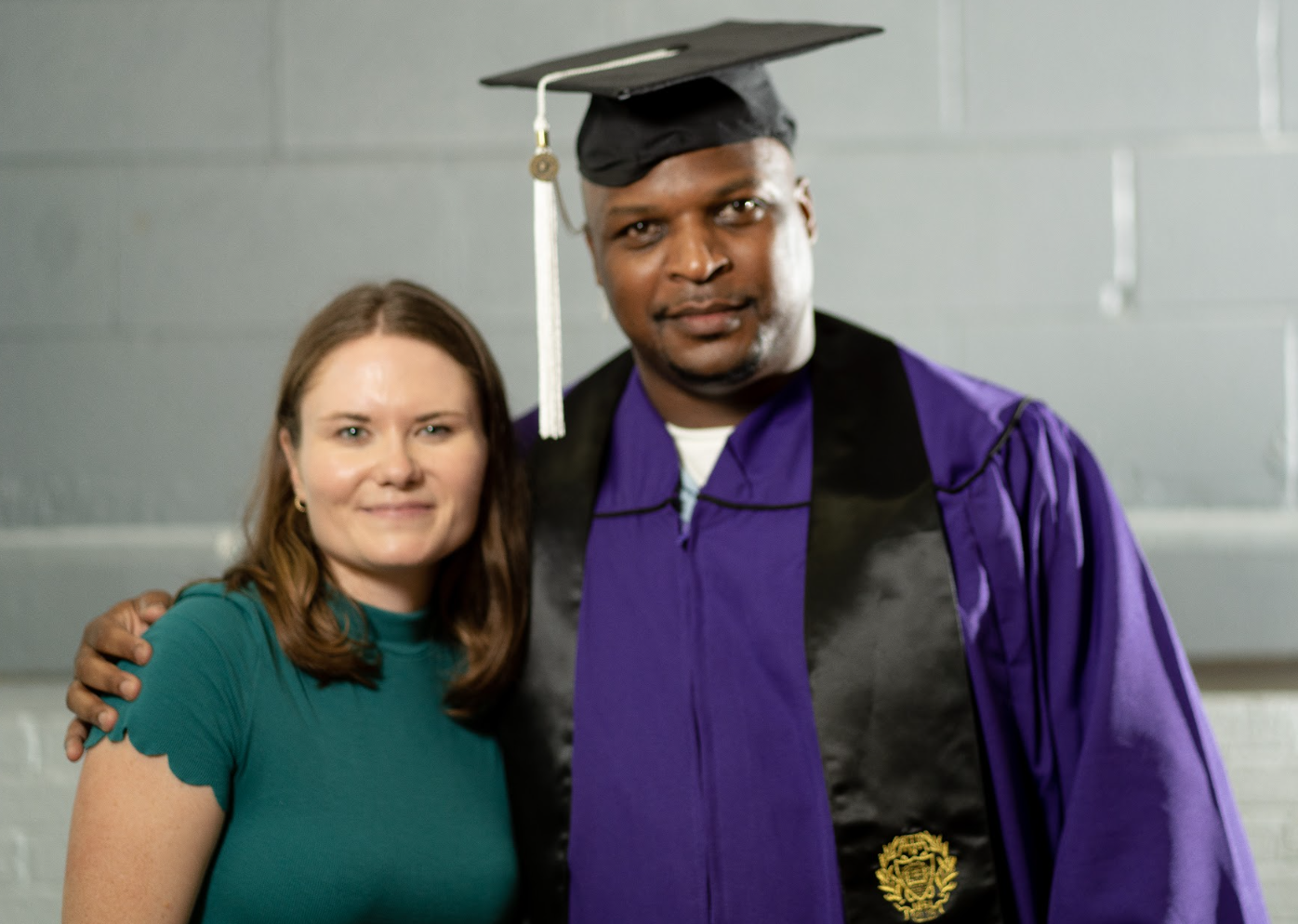
On November 15, 2023, Monika Wnuk and several media photographers gathered to attend an historic Northwestern graduation: 16 men received their bachelor’s degrees, the first time in U.S. history that a top 10 university would confer such degrees on incarcerated students.
With a camera around her neck and several lenses in tow, Monika zig-zagged between students, their families, and other guests who filled the theater at Stateville Correctional Center. However, Monika wasn't with one of the media outlets such as ABC, CBS, and Reuters who were there that day; she was there for the Northwestern Prison Education Program (NPEP).
Despite sharing the same profession as those around her, she had an advantage over every photographer present. Before this day, Monika had been to Stateville well over ten times; this was her third graduation in the same exact building.
While the media was there to tell a story for that day, Monika—who knew us individually, our academic journeys that brought us to this day—was there to document another day in our academic journey. “I’m not just documenting their day,” she said, referring to us. “I’m documenting a moment in their life.”
“To see those original NPEP students, who paved the way, in their purple gowns was such a proud moment,” Wnuk continued. “I also loved seeing the outpouring of love and support from the faculty and families and taking so many family photos that day.”
Before that momentous day, our journey with Monika started eight years ago. She visited Stateville for the first time in 2018 as part of the Northwestern Office of Global Marketing and Communications, where she worked as its multimedia producer, writing and photographing stories about Northwestern’s faculty and students.
On that day, she arrived in the education building wearing a fleece Medill-branded sweatshirt and blue jeans. I instantly assumed she was a journalist.
Most volunteers who come to Stateville for the first time are nervous and timid. However, Monika was the total opposite. I still remember her firm handshake and welcoming smile when she introduced herself. Her smile put us at ease.
Within the first five minutes of watching her work, I realized she wasn’t the average photographer. While most photographers made their presence known, she was the total opposite. She was stealthy; she could capture authentic moments without inserting herself into them. If it weren’t for the click of her camera, you wouldn’t even know she was there.
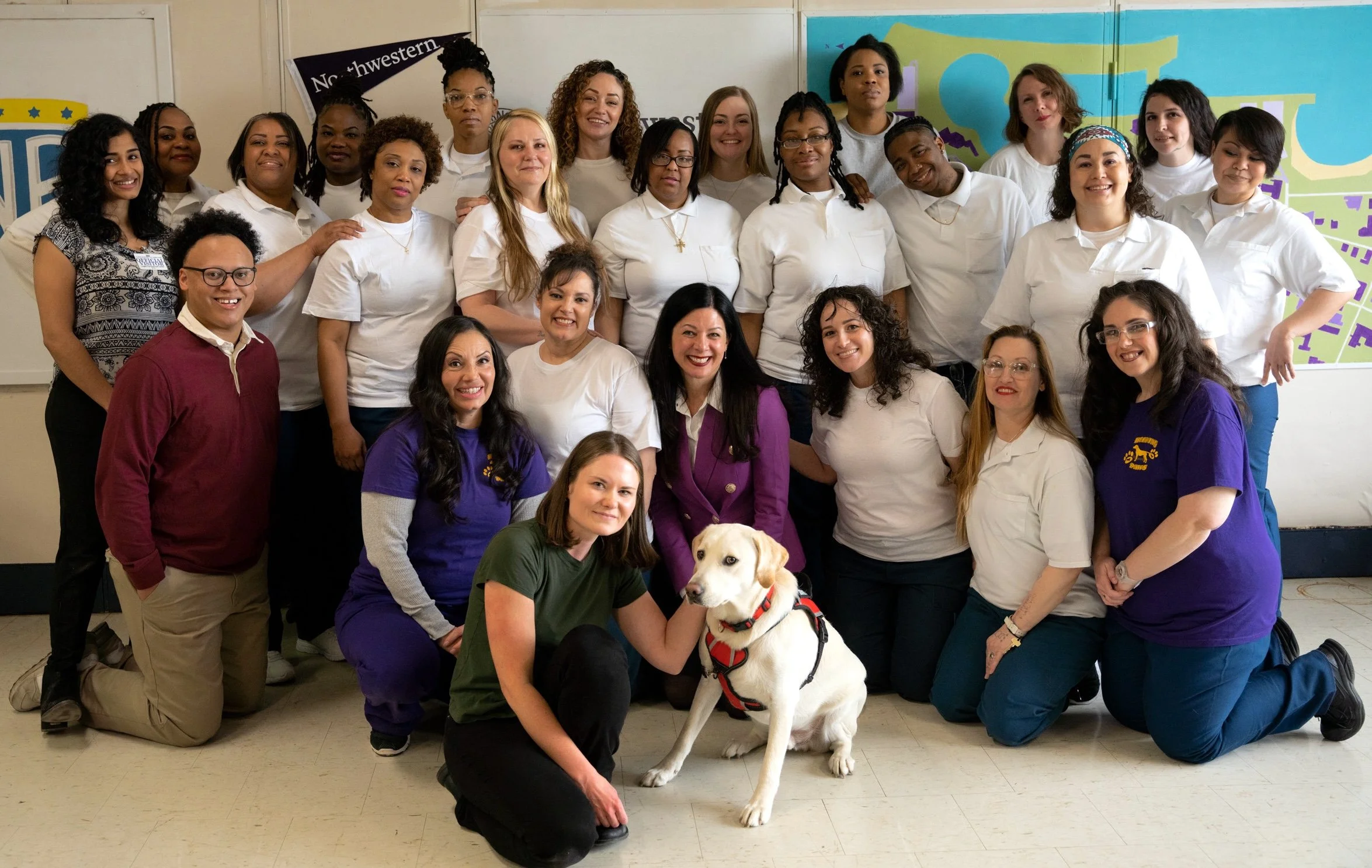
Monika (front left) and the NPEP class at Logan Correctional Center.
“For me, photography is a very social art form,” Monika said. “You get to paint with light and compose and capture scenes, but you also get to help tell the stories of your subjects. To do that, you get to connect with them, learn a lot about them and, through earning their trust, gain access to intimate moments in their lives.”
Monika’s interest in photography has family ties. She grew up around photographers, including her uncle, a former photojournalist who worked in communist Poland in the 1970s. “Seeing his collection of photos from that time felt like peering into a time capsule of what daily life was like back then,” Wnuk said. “I have always loved taking pictures, but it wasn’t until I was at Medill learning about photojournalism that I realized it was something I could do as a career.”
Since graduating, Monika has spent the last decade learning photography “on the job,” shooting for nonprofits, universities, families, and NPEP. She’s worked at Northwestern University’s Institute of Sustainability and Energy and the Office of Global Communications and Marketing. Since 2020, she’s worked with AARP as an associate state director of marketing and communications.
If you ask any incarcerated resident what one of their most prized possessions is, they’ll probably say their “pictures”—frozen images in time, a social resume of who they used to be before their incarceration.
Unfortunately, all the images of us were in the “past.” We dwell on photos of loved ones that allow us to embrace the present, see see their journey from the inside, and visualize the important moments in their lives. But our loved ones did not have current photos of us.
Monika Wnuk has allowed students in the NPEP community an opportunity to be seen through a different lens. Whether it’s a graduation, gown fitting or just a regular day in class, she allows us to share our NPEP experience with the ones we love. They’re able to embark on the journey with us.
“When I get to shoot [students] with their families, I’m documenting a piece of their family history and making sure that the students are able to be a part of it,” she said.
Before my enrollment in NPEP, my mother had one picture of me. It was a picture of me on Mother’s Day. I was about eighty pounds lighter with a head full of hair (for those of you who don’t know, I’m bald). For the first 11 years of my incarceration, my mom would stare at that picture endlessly while the tears escaped her eyes. My mom calls it a memorable moment.
Fast-forward to the present day, and she has a photo album of my academic journey in NPEP that she shows off to her friends and family. None of that would have ever been possible without Monika Wnuk.
On behalf of the entire NPEP community, Monika, thank you for allowing us to share and showcase our academic journey with the ones we love.