Inside the ClassroomVol. 1, Issue 1
Turning Prisons Into Classrooms
The importance of education in carceral settings.
There is a common misconception that prisons are designed to rehabilitate people, that prisoners receive an education or learn a trade.
In my view, nothing could be further from the truth. Correctional systems don’t correct anything. Instead, they resist attempts and opportunities to make you better. They pay lip service to the word “rehabilitation,” and then do nothing to help you achieve it.
It took someone from the outside to see the value in people in prison and to truly provide us with a rehabilitative opportunity.
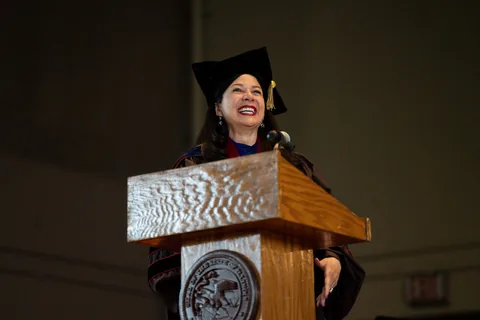
Her name is Jennifer Lackey. She is the Wayne and Elizabeth Jones Professor of Philosophy at Northwestern University, and the founder and director of the Northwestern Prison Education Program (NPEP).
After teaching two classes at Stateville Correctional Center in 2016 and 2017, Lackey saw firsthand the lack of educational opportunities. But she also saw a thirst for knowledge from her students.
So in 2018, she launched NPEP, an initiative of Northwestern University that partners with Oakton College and the Illinois Department of Corrections.
NPEP was the first degree-granting program in the state providing a full liberal arts curriculum to incarcerated students. The work and content are equivalent to that taught on the Evanston and Chicago campuses.
With great humility and profound happiness, I was one of 20 applicants selected to be in the first cohort of NPEP students. In 2022, the cohort received associate’s degrees from Oakton College. Many students graduated with honors.
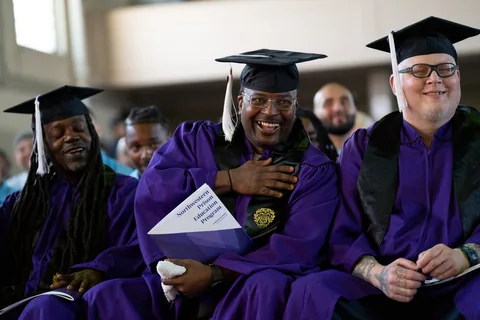
On Nov. 15, 2023, we made history by graduating with our bachelor’s degree from Northwestern — the first incarcerated students in U.S. history to graduate from a top 10 university. Once again, many of us graduated with honors.
If not for Professor Lackey and Northwestern, I would never have received an education.
You see, I have a natural life sentence, and the state of Illinois has a long-standing policy not to bother educating people with long-term sentences.
Since I entered the correctional system, I’ve tried to get educated. When I was on death row, I tried to take some classes. I was told, “We’re going to execute you. It’s not worth the time.” Fair enough, I suppose.
After I got off death row, I tried once again. Since I already had my GED, I wanted to take some college classes or even some vocational classes. Once again, they said I wasn't worth being educated. “It’s a waste of time to educate guys like you,” I was told. By “guys like me,” he meant those of us with long-term prison sentences.
I’ve often described incarceration as a “waste management system.” Society views us as garbage and throws us away, so opportunities for rehabilitation do not exist. As a byproduct of mass incarceration in the 1990s, college and vocational programs were abandoned. Instead, they turned to warehousing people in increasingly inhumane conditions.
But education is not only important — it is a basic human right that has the power to change lives. Education has the ability to contextualize your past, alter and broaden your outlook on the present, and change your future.
Men and women in prison have made mistakes. Some have hurt people, yet we laugh and cry, struggle and grow like everyone else. To say that we aren’t even worth being educated strips us of our humanity. It tells us that we are nothing, that we have no value. That is what they think of us, and it is what they want us to think of ourselves.
When men and women do get out of prison, how can it be in society’s best interests for men and women to get out uneducated? How exactly does that make society safer? An incarcerated person who receives an education makes society safer, and education is an investment that society can’t afford not to make. Education is a tactic that is already working, and it is my belief that it should be a mandatory part of every person’s prison sentence.
When COVID-19 hit in the winter of 2020, it changed everything for us. At Stateville, NPEP students were forced to communicate and learn strictly through correspondence.
The lack of a classroom setting and isolation were difficult. Men around us died. We lost many friends. I lost my cellmate and best friend James Scott. Some men lost family members at home.
Studying in prison during the best of times is tough, but during COVID this was an unbelievable struggle. But we held on to our education as an anchor amid a shifting sea. The difficulty of our lives and the courses themselves made us struggle to be more, to grow and be better.
Every one of us in this program has struggled and fought against all odds to learn, to grow, and to become the best versions of ourselves. For that reason, it is my belief that the people in this program have self-rehabilitated.
They are smart, and because they are graduates from Northwestern, now the world knows it. They are confident and sure of their own worth. They have a drive to continue to be better. All of us have had goals and aspirations that once seemed like a dream, but now everything feels attainable.
I marvel at the journey I've had. From being homeless and on my own at 13, reading a book by the light of a street lamp, being told over and over that I wasn't worth being educated, that I had no value to now graduating with honors and getting my bachelor's degree. I am a living success story.
With confidence I can say that all of NPEP’s graduates and graduates-in-progress are outstanding members of the community here and would be outstanding members of any community in the outside world.
Programs like NPEP are the epitome of what rehabilitation is all about.
“These graduates are journalists and teaching fellows, artists and published authors, mentors and restorative justice facilitators. They exude wisdom, compassion, and confidence in leadership. If anyone ever questions the value or impact of education, I'm confident that spending one day with the recent NPEP graduates will change their mind.”
- Writer
- Anthony Ehlers
- First published
- Vol. 1, Issue 1 · 2024 · pp. 9–10
- Original edition
- Download the issue (PDF) (opens in a new tab)