Call & Response: 42 and Freedom
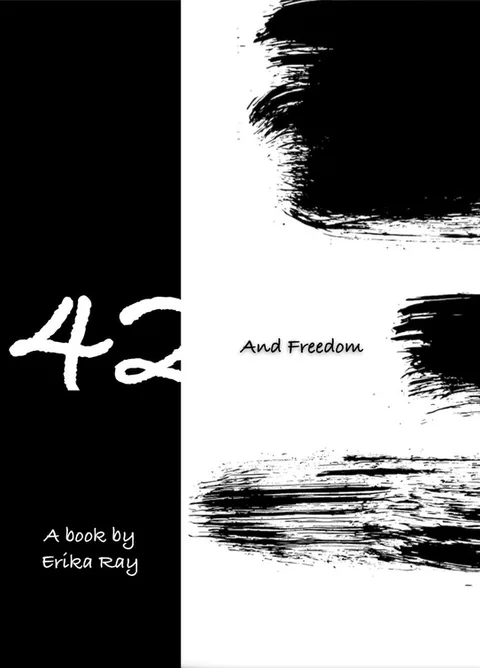
To celebrate the release of NPEP student Erika Ray’s new collection of poetry 42 and Freedom, the Northwestern Insider has published four of her poems. Two NPEP students, Dré Patterson and Broderick Hollins, respond with their reactions after reading.
“42 and Freedom is a collection of poetry I put together with the hope of expressing a reality that some women and girls, especially those of color, encounter,” Erika said. “While writing these poems, it was my hope to thread together how we survive racism, sexual violence, systemic violence, and rejection while highlighting the resilience of melanated people. Once a person is incarcerated, everything is stripped away; this often includes self-care. Creating this project was my year-long commitment to self-care.”
Buy 42 and Freedom on Amazon. (opens in a new tab)
What I Choose
Every day I choose to go on livingin an unsteady world that makesdeath seem easythere are no passions here
and dreams are a nostalgic imaginatory indulgencefor those who cannot pass goor collect their things and spring forward fromthe days that bleed and blend into each other
no sunrise or pink moonsto capture the breathof dreaming mothersbut we go on living
hoping for a steady worldthat will make us fear death
Response
Sis came out swinging with a soul-piercing sword. I immediately felt Mother Soyini’s Poetry and Performance class reflexively kick in. I'm noticing how the enjambments Erika uses reflect the meaning, how the words dictate the pace.
If you are reading this out loud, each line bleeds and blends into the next with no chance to catch your literal breath — or mental breath, if you are reading silently. There’s no period, no comma, no grammatical symbol that signals your consciousness to pause. I especially like this last pair of lines:
hoping for a steady world that will make us fear death
It expresses the existential anxiety that prisoners feel daily, questioning whether death would be more welcome than this.
Unheard Women Poets
don’t you think you should be quietyes, I know you can talkmanipulate words and verbsin ways that make me feel heard
heard is what you shouldaim not to beuse your gift of beautyand become a part of the scenery
in stillness
a girl and woman’s place
don’t be too much Ntozakeor too wrapped up in Nikki Giovannior overgrown in the sounds or talkingback of bell hooks
what sound can you makeif your mouth is closed?if the vibration of words stopsbefore they leave your soul
poet
they won’t call youbecause you owe a woman’s debtpoet they won’t call youbecause they have not heard you yet.
Response
“42 and Freedom” is energy to us impacted by the system, a powerful tool to get us by. “Unheard Women Poets” is no different.
Acknowledging this and speaking your mind through pen and paper is more valuable than speaking out loud — because with your words in writing we can go and grab onto your thoughts and your voice.
Another Poet
I am just another poet, so as you can imagine/ words roll off my lips easily, like the spreading of jam instead of jelly/ I am just another poet. When I write, memories of Suge in her sexy sparkly red dress flood me/ because I am sister/ A Sister Poet/ speaking for me, you, her, us, all women/ an unheard poet/ locked inside of a fearless warrior/ I am just another poet, words spilling from my pen like white excited eyes watching “Gone with the Wind”/ I am a poet/ just another poet, beautifully black like Sydney/ profoundly majestic like Ava/ unearthly phenomenal like Maya/ I am just another poet/ draped in dreams/ dripping with an incentive for her/she/they that are brave enough to step in front of my words/ I am just another poet/ just another/ just another/ another/ poet.
Response (a poem)
I thought I was brave enough –She told me there was an incentiveIf I just stood there and took the shotsNo cover up.But I had on a vest.As her words pummeled me with the sharpness of body piercingArmor piercers,I realized that I wasn’t actually beingBrave.I shed the vest.Stop HidingThat’s what I’m talkin’ ’bout.She took aim.I poked out my chest like I thought a man wasSupposed to do,Secretly hoping that I would be immune to her arsenalLike the OankaliIn an Octavia Butler story.
But the very first shotWas to the dome,Piercing my psycheThreatening toFree me.As I lost consciousnessI askedDo I really want thisFree “dome”?
Prone To
Stokely Carmichaelbelieved that a Black woman does her bestwork in the prone position
Someone should tell him that she is now prone to– intimate partner violence– incarceration– isolation– sullenness– silence
all things you have to lay down for.
Response
This piece hits hard. I first came across this quote by Stokely Carmichael a year or so ago. He was pushing back against the Black feminist voice calling for Black women to have more equitable positions within the various civil rights movements: “the only position for women in SNCC [Student Nonviolent Coordinating Committee] is prone.”
I had to look up prone: “lying flat or prostrate.”
What? Fighting against the oppressor and you oppressing your closest “rappie” (co-defendant)!
- Poet
- Erika Ray
- First published
- Vol. 1, Issue 1 · 2024 · pp. 20–24
- Original edition
- Download the issue (PDF) (opens in a new tab)