Restorative JusticeVol. 2, Issue 1
A Survivor's Guilt
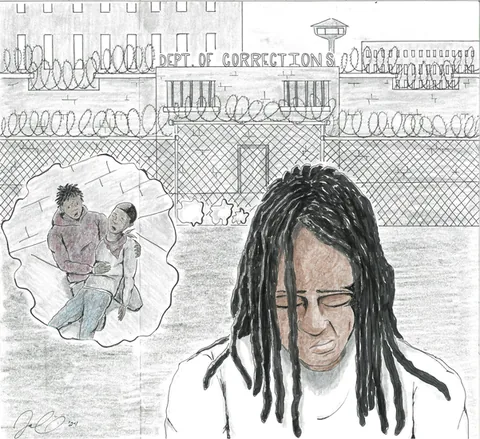
How can someone who inherited poverty, distrust, and substance abuse — and then exchanged those circumstances for a 20-year prison sentence — suggest they're suffering from survivor’s guilt? Yet, scenarios exist where traumatic events leave people neither victims nor victors. New dawns carry yesterday's baggage.
The importance of an all-inclusive, supportive outlet where people can take accountability, express remorse, and make amends beyond mere apologies can be instrumental in our transformation process — especially for men who are often unwilling to share their emotions. As we honor victims, it is important to show the humanity of those convicted of crimes to begin to repair the harm that lingers after interpersonal damage.
With that said, I’d like to show support for Tevin Louis, whose co-defendant was shot and killed by responding officers. For the last 12 years, Tevin has sought to honor his friend’s memory but finds it difficult while he stands convicted of his friend’s death. Recently, Tevin shared what it feels like to deal with his form of survivor’s guilt. His poem can be found on the following page.
- Writer
- Donnell Green
- Illustration
- Jason Gorham
- First published
- Vol. 2, Issue 1 · 2025 · p. 85
- Original edition
- Download the issue (PDF) (opens in a new tab)