Language of the Law
Facing a lifetime in prison, Paul Forbes turned to the law library to
rewrite his narrative.
By Paul Forbes
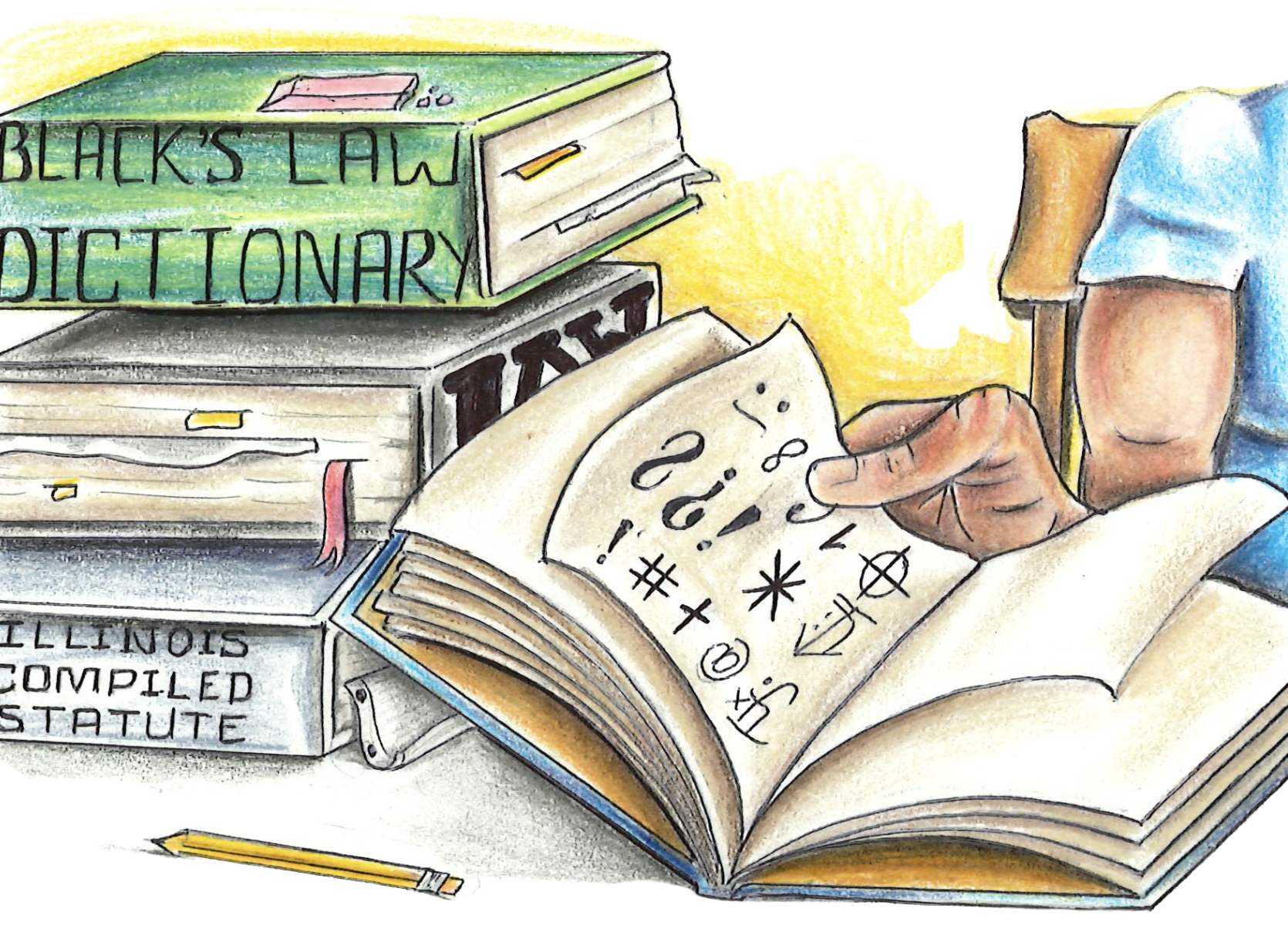
Illustration by Hugo Ocon
On August 24, 2015, the bars slammed shut, and I began pacing back and forth in the cell, silently asking myself, What have I done?
I replayed everything that had transpired, realizing I was in deep trouble. I knew I had committed a serious crime, but I had no idea how to help myself. I didn’t understand the law or know a good lawyer who could take my case. That night, I lay awake staring at the ceiling, wondering what their investigation would prove.
Three days later, at my first court date, I was nervous and afraid. During the investigation, I learned that two people had lost their lives because of my actions. I didn’t know what to expect as I stood before the judge and listened to the counts in my indictment. When I heard multiple counts of first-degree murder and several counts of fleeing and eluding, my jaw dropped, and my heart skipped a beat. I was facing a sentence of 40 to 120 years, with no possibility of early release.
At 25 years old, I would be between 65 and 145 years old upon release.
This is what you deserve, part of me thought. But another part knew that wasn’t my intention. Hearing words and terms I didn’t understand, I realized that if I wanted to breathe fresh air again, I needed to learn the language of the law.
The following day, I started asking older men on the tier about the words and terms I’d heard in court. They directed me to the law library, and I began my journey to understand the judicial system. I recalled a childhood memory from third grade, when my teacher, Mrs. Washington, gave us 10 words each week to study. We had to write each word 10 times, find its meaning, and use it in a sentence. I applied the same method to learning legal terms.
That night, I submitted a request slip to visit the law library. A week later, I was sitting in the dayroom watching the five o’clock news when the correctional officer came by with the mail. I received notice that I was approved to visit the law library and a letter from my older brother, Calvin Merritte. In the letter, Calvin told me I was being overcharged and directed me to specific library resources: the Illinois Compiled Statutes books, West’s Smith-Hurd Illinois Compiled Statutes, and Black’s Law Dictionary.
The Illinois Compiled Statutes explained the counts on my indictment and related mitigated offenses. The Smith-Hurd books contained case law and outcomes to help prepare arguments and anticipate the state’s response. Black’s Law Dictionary defined the legal terms used in the courtroom. Armed with these tools, I gained the confidence to speak up in court and challenge my lawyer when we met.
For instance, when my lawyer insisted on a jury trial, I argued for a bench trial, understanding that my case relied solely on legal interpretation. I believed the average person lacked the legal knowledge necessary to serve as a fair juror. My decision to opt for a bench trial would later prove beneficial.
Although I had only a beginner’s understanding of the law, I quickly realized the State Attorney’s objective was not justice for the victims’ families but to exact an eye-for-an-eye punishment. This infuriated me because I expected fairness in a court of law. I was wrong. I knew I had to take responsibility for my actions, but the judicial system prepared me for a different battle: fighting for my life.
As I read more cases and researched further, I became aware of the carceral injustices within the judicial system. I saw police officers lie on the stand, give false testimonies, tamper with evidence, and submit coerced confessions—all without facing the consequences. This deepened my resolve to understand the law.
“I knew I had to take responsibility for my actions, but the judicial system prepared me for a different battle: fighting for my life.”
Using a prison kiosk computer system to research legal information, I studied reckless homicide, a lesser charge than first-degree murder. My research led me to two key cases: Belk and Schmidt. By “shepardizing” these cases (using a legal citator to find related rulings), I found precedents where appellate courts reversed decisions due to circumstances similar to mine. These cases helped me argue that my actions, though reckless, were not intentional, resulting in a reduced charge of reckless homicide.
In April 2018, my bench trial began. I was appropriately fearful but prepared. For four days, I watched the State’s Attorneys portray me as a lawless monster. My lawyer, however, acknowledged my actions and demonstrated how the facts of the case aligned with reckless homicide rather than first-degree murder. The judge agreed, and because I had chosen a bench trial, they had the authority to reduce my charge and sentence me under the correct statute.
The trial ended that month, but my case continued until June for a pre-sentencing investigation (PSI). During the PSI, my life was put under a microscope. Every action I’d taken as an adult—excluding juvenile history—was scrutinized to assess my rehabilitation potential.
At sentencing, I felt at peace because I fought for a sentence I deserved, not the one the State’s Attorneys had sought. The judge sentenced me to 24 years, but under the law, I was only required to serve 50% of that time if I met certain conditions. This meant I could be released in just a few years—a far cry from the effective lifetime sentence I had initially faced.
The judicial system I encountered isn’t about fairness but punishment. My journey to understand the language of the law taught me that knowledge is powerful, education is transformative, and justice is not always served—we must sometimes fight for it.
