Foreign Language
Decoding the language my father had been speaking all along.
By Scot Miller
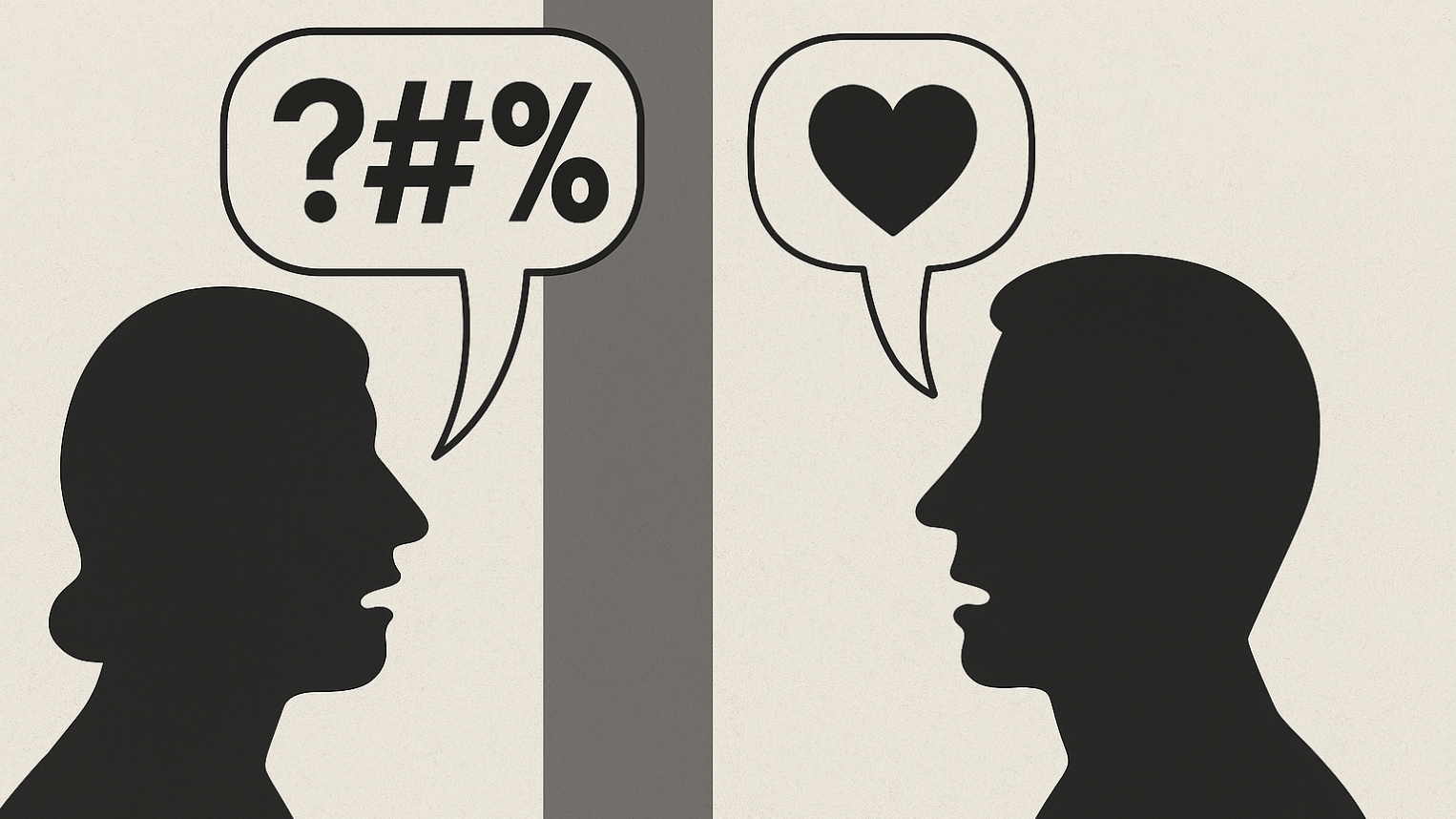
Parents are difficult to understand even in the best of times.
Most of my life my dad, Ron, has seemed like he was from a different planet and spoke a foreign language. He never shared much of his life’s story with us, and to this day I am still trying to piece together the puzzle that is my father. He is an austere man. Although he was usually deadpan, he wasn’t without a sense of humor. When we were growing up, my dad didn’t often prank us or play around, but occasionally he would say some witty comment making one of us kids the butt of the joke. He loved watching old sitcoms, and I would hear him laughing out loud while watching re-runs of M.A.S.H. or All in the Family.
My dad was very affectionate when we were children. I remember when he came home from work, my brother and I would race to the door to jump into his arms, hugging and kissing him. Once my sister was born he didn’t want to be separated from her.
Some of my most vivid memories of my father were of the crazy gifts he would give for Christmas. Every year, he would buy us presents that none of us wanted—or at the very least, a bad version of a thing that we vaguely desired.
Occasionally, one of us would receive a gift that another sibling actually did want. I remember that he bought my brother a robot named 2XL. This robot played cassette tapes with all types of scientific information on them. The thing was, my brother hated robots and science, whereas I loved both. If I asked about the gift mixup, Dad would say , “I knew one of y’all wanted it.” At the time, I thought that his weird gifts were just one of his idiosyncrasies.
My father gave nicknames to everyone in the family: he called me “Hillbilly” because I didn’t like wearing shoes. My little sister was “Stinky-Winkey” or “Stink” for short, because of an accident she had in the bathtub as a toddler. My older brother was “Gushy-Main.” I have no idea why my father called him that. There’s no doubt that the nicknames are terms of endearment, yet the names add to the enigma that is my dad. My siblings and I never used these monikers for each other, but as young adults we teased each other about the bizarre nicknames that Dad gave us. To us, the names were just another piece of his mysterious mind.
Like most younger brothers, I looked up to my older brother, so when he joined the Boy Scouts I wanted to join too. My dad became a Scout Master so he could spend time with his boys. We all enjoyed camping trips, earning merit badges, and doing things together as a family. Things began to change in my pre-teen years, though.
My brother became interested in sports, which meant I became interested in sports. Unfortunately, my dad was never into sports. I found out that I was not a bad athlete, so I became more involved in football, eventually leading to me leaving the Scouts.
At the time, I didn’t realize how much leaving the Scouts might have hurt my dad, though he never said so. Then again, he wasn’t the type to say anything. His disappointment showed in quiet detachment.
He wasn’t as involved in what I did at school or in my extracurricular activities, and I couldn’t understand why. I desperately wanted him to show up to my games to cheer me on, but he always had to work. I assumed his retreat from me was because he thought we didn’t need as much attention as we had when we were younger. Sometimes, however, it felt like he didn’t care as much as he once did. It never occurred to me that my actions may have hurt him, especially since I saw him as unassailable.
As the years went by, the gulf between us grew. My father and I didn’t talk much once I started high school. Part of it was my newfound independence as a teenager, but I also didn’t feel much effort on his part. He still gave us crazy gifts and he attended all the major events in my life, but the relationship wasn’t the same. The connection seemed damaged, and as a result, I began to feel indifferent toward him, mostly out of hurt.
My father worked the midnight shift which meant that he normally slept during the day. His schedule allowed me to cut class and hang out with my friends at our house, provided that we didn’t wake him. At our house my friends and I would dip into my parents’ liquor stash. I was a shy kid and I quickly learned that I could get rid of my shyness by getting lost in alcohol. I soon began to drink excessively because I liked the way alcohol made me outgoing to the point where I was rarely sober. Looking back, I may have been fighting a much larger demon than shyness: depression.
Eventually I began to abuse marijuana as well as alcohol, though I still managed to maintain good grades. I started to hang out with people who may have been considered “bad influences” and had a couple of run-ins with the law. No doubt my father saw his baby boy spiraling out of control. At this time the crack epidemic hit our neighborhood, and my family saw our community change for the worse. Being able to sustain good grades may have been the only reason that my parents didn’t have a full-fledged intervention for me.
During this time, the late ’80s, many of my friends’ parents were divorcing or their fathers were simply leaving. My father stayed. I don’t believe my father knew how to correct the path I was on or the trouble I was getting into. I was hanging out and becoming more involved in the streets; my behavior worked as even more of a wedge between us.
Miraculously I was able to graduate high school and get accepted into Tuskegee University. The day that I left for college, my parents drove me to the airport. As I was unloading my luggage from the car, my dad discreetly slipped me some money without my mother noticing.
It felt like a spark of our old bond had been rekindled. I distinctly remember sitting on the plane, reminiscing about my childhood and the times my dad and I would share root beer floats together.
Unfortunately, after a couple of years, I dropped out of college and returned home. I was embarrassed that I had let my family and myself down. My father never said anything to me about my failure. He ignored it, and me. The chasm between us returned.
For years our rift remained. There was no hostility, but the silence between us was more heartbreaking than any argument could have been. My siblings also felt my father’s emotional departure. They grew angry, while I became apathetic. To me, my father no longer cared and I didn’t either.
That changed when I was arrested for a major crime. As soon as I was taken into custody, my father moved heaven and earth to secure an attorney for me. Unbeknownst to me, shortly after my arrest, my mother was diagnosed with cancer. I can only imagine what my dad was going through mentally — fighting wars on two fronts while working the graveyard shift. What I do know is that my father attended every single one of my court appearances, many of which lasted only a few minutes. His presence helped sustain me through the most difficult time in my life.
Seeing him show up for brief and insignificant court hearings forced me to reevaluate my perception of my father’s love. My trial ended in a guilty verdict and my father took the stand in an effort to mitigate my prison sentence. Initially, I was apprehensive about my father testifying on my behalf because I felt that I had already put my family through so much and I did not want to add more to the burden.
Approximately four years after I was transferred from the county jail to the state prison, my mother was placed on hospice. Sadly, she passed away on Mother’s Day in 2004. Up until that point, she had been my rock and comforter. With her gone, I didn’t know how I was going to survive what amounted to a life sentence. To my surprise my father stepped in to fill the gap in a major way.
My father and I began speaking on the phone weekly, which was unusual for us. At first, our conversations were awkward and superficial; it was like I was getting to know a stranger. He made sure that I was able to speak to my son who would spend weekends with him. I couldn’t help but have a new appreciation for my father.
Years later, as I was participating in an inside-out dads class, I borrowed a book entitled The Five Love Languages by Gary Chapman. This book was like the Rosetta Stone to my father’s enigmatic mind. It showed me that people express their love in various ways, one of them being “gifts of love.” I read the chapter on gifts over and over, reminiscing on the presents my father gave.
Replaying the images of past holidays and considering how my father sat transfixed on watching our reactions as we opened gifts made my breath catch. I hadn’t understood it then, but now, with this book in my hands, I could finally see it: the joy, the intent, the meaning behind what he had been saying all along.
Love Languages caused me to think back to when I was a kid and my father would take me to the mall to pick out presents for the family. He would spend, what seemed to my adolescent mind, an eternity selecting greeting cards when all that I wanted to do was get to the toy store. I hadn’t a clue that what he was so painstakingly searching for was the perfect card that expressed his love towards his family. These cards were his way of laying his soul bare to us. I was focused on the presents when the true gift was the text of the cards. It all made sense now; he had been sharing his feelings all of my life but I wasn’t listening. I had been discarding the cards, and thus, his feelings. I understand now that his gift-giving was an outward manifestation of his love and thoughtfulness.
Another of my father’s love languages that Chapman notes is “acts of service,” which means that he tends to articulate his love much more eloquently with actions rather than with words. His service was expressed in multiple ways, such as by showing up to every court hearing. His paternal service became apparent to me when I observed him navigating the predatory financial practices imposed on the families of prisoners by the Department of Corrections. He never abandoned my struggle in prison even when those hardships caused him to sacrifice an excessive amount of personal and financial capital.
“I hadn’t understood it then, but now, with this book in my hands, I could finally see it: the joy, the intent, the meaning behind what he had been saying all along.”
My dad has been through so much: triple bypass heart surgery, amputation, of one leg, a heart valve replacement, a pacemaker installment, and dialysis three times a week. My father’s strength is incontrovertible. When Dad was having heart surgery, he flatlined during the procedure and had to be resuscitated. When I spoke to him post-op, the only thing he wanted to talk about was me and how I was doing in school. His dedication to family is mind-blowing.
My father was also instrumental in me maintaining longstanding familial bonds, none as notable as the bond with my son. My dad unceasingly continued to attend to the needs of my family and me, even when going through health challenges.
After all this time I finally got it—I learned to speak Ron. Even now, I attempt to teach the rest of my family to comprehend my father’s love language. It’s not easy, but he deserves to be understood. Despite all the tribulations my father has stared down, he always puts his family first. It took all of my life, but I am glad that I have finally become fluent in my father’s love language.
