Learning From My Father
Everything I needed to know, I learned from him.
By Bryan Dean
What assumptions do you have about people who never make it to high school? Dumb? Perhaps unreliable?
I know a man who never made it to high school, and he is one of the wisest people I know: my father. Though he didn’t go far in the traditional educational route, my father has an incredible knowledge base that has proved invaluable throughout his life and mine. Through the course of our many years and interactions together, I’m fortunate to have learned much from my father, including how to be “handy.”
My father is a 69-year-old Black man. Born in Georgia in the 1950s, he personally witnessed and experienced racism on a regular basis—on his walks to and from school, inside the actual schoolhouse, and later in life when searching for jobs.
Though my father admittedly didn’t perform well in school, he found other ways to engage his mind and show his intelligence.
When I read Mike Rose’s essay “Blue-Collar Brilliance,” I saw my father reflected in Rose’s Uncle Joe. My father is incredibly savvy at working with and fixing machines, making alterations of his own creation to strengthen their operation (or to avoid future breakdowns), and demonstrating his skill in a way that allows others to learn—assuming he has the time to teach, and you want to learn.
I started learning from my father in early childhood. I was a very blessed child. I had toys, a television, and a Nintendo. I thought that was normal. Everybody gets these things, right? It wasn’t until my father mentioned that he hadn’t had those luxuries in his childhood that I realized how lucky I was. But of course, I had to ask: If you didn’t have Nintendo, what did you do for fun?
My father helped me imagine. Growing up in the hilly lands of Georgia, my father, his brothers, and their neighborhood friends would race wagons and carts down long hills. When my dad told me these stories, I pictured hot, sunny days with vibrant grass on either side of a long, exhilarating hill—an idyllic scene where the kids raced in fierce competition. When I asked how they managed to get the wagons and carts, he told me, “We built them.”
Can you imagine my awe at 5 or 6 years old hearing that? They built them? Where? How? They were kids. Could I build one? Never mind that we lived on the flat streets of Chicago. I wanted to race a cart down a hill.
As far back as I can remember, my father was always a particularly handy individual. He was a foreman at a factory with enormous injection molding machines. On the occasions I went to work with him, I learned that my dad was the go-to person anytime a machine malfunctioned—especially if it had completely stopped working. I’d watch in awe as he maneuvered around, under, and sometimes on top of the machines, fearlessly fixing whatever the problem was. He was confident but careful. He knew people had lost digits and limbs in those machines, but he also knew what he was doing.
The first few times I asked to help fix a machine, of course, his response was a stern “No.” I’d be upset, wanting to learn and be like him. “Go stand over there,” he’d say, directing me to a spot where I could watch him and where he could also keep an eye on me.
One day at the factory, we arrived before his shift started. We walked to the cabinet that housed his toolkit. As he began examining his tools, he pointed to specific ones, telling me their names. An unexplainable excitement grew within me.
Though I was just learning what a flathead and Phillips head screwdriver were, I felt like I was becoming like him.
That day he let me “help.” As he worked on a machine, he’d tell me which screwdriver to grab. Patiently, he’d correct me when I brought the wrong one. “No, that’s a Phillips. The big flathead has the green handle.” I’d return with the correct tool, intent on remembering that the flathead had, well, a flat head.
Sometimes, when we were at home, people from the factory would call my dad to come in and fix something they couldn’t figure out. He’d ask if I wanted to go with him, and I’d happily tag along. Some of the people there were well educated and had degrees, but Pops knew how to solve problems that left them stumped.
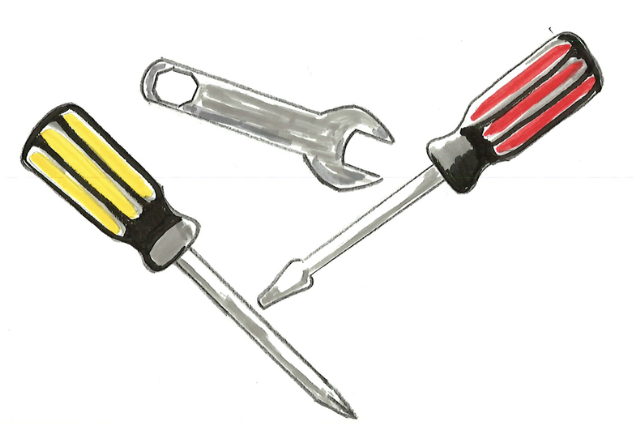
Illustration by Hugo Ocon
Outside of work, his skill proved just as valuable—around the house, for relatives and friends, and for a video-game-obsessed version of me. When my Nintendo controller stopped working one day, I asked my dad to buy me a new one.
“What’s wrong with the one you got?” he asked.
“It broke! It won’t work!”
Calmly, he walked over, put a hand on my shoulder, and said, “We’re gonna fix it.” I sat enthralled, watching everything he did, soaking it all in. After he put the controller back together and checked that it worked, I opened up my second controller—the one I reserved for cousins and guests—and I repeated all the same steps myself.
Catching on to what I was doing, my father watched as I reassembled the controller, plugged it into the Nintendo, and started the game.
“It works!” I shouted.
He smiled wide, gave me a quick “Yup,” and walked into his room while I got lost in the game.
I’d just learned how to open something, examine its components, and put it back together correctly. That gave me a little bit of knowledge, skill, and confidence. Soon I was exploring the inner workings of other things as they broke: TV remotes, VCRs, remote control cars, and more.
Where I learned even more was in working on actual cars. No longer was it just flathead or Phillips head screwdrivers. I began to learn about socket wrenches, various socket sizes, spark plug gaps, and oil filter wrenches. I learned the difference between a deep well socket and a spark plug socket (the latter has a rubber gasket inside). I helped as we changed alternators, fixed brakes, did tune-ups, and replaced fuel filters.
I learned the importance of buying the right wire harness when installing an aftermarket stereo, the role of power capacitors when installing an amplifier and subwoofers, and how to mount and hide a CD changer in a car. Once, while changing a thermostat, I was surprised to learn we didn’t need to own every tool. AutoZone would loan them to you for free. We went there so often, they knew us as soon as we walked in.
My father had a special ingenuity when it came to solving problems. One day I asked, “Did you use to win your races, Dad?”
“What?! Boy. I had some bad stuff!”
We’d sit around smiling and laughing as he retold stories to me and my sister. He’d describe how my uncle lost control of his wagon and tumbled down the hill, how kids sped into curbs—or worse, into cars—at the bottom.
He may not have excelled at math and history in school, but my dad was far from dumb.
“I was the first kid to put brakes on his wagon.”
“Nuh-uh!”
“Yeah I did! Then your uncle stole my wagon and tore my shit up!” Again, we’d be near tears from laughing.
That same ingenuity helped him later in life. Pops began as a machine operator at the factory where I later learned what a flathead screwdriver was. He worked his way up the ladder, learning the machinery, solving problems, and even improving operations—like when he tweaked the plastic release valves on the injection molds to reduce excess output and waste.
He didn’t learn that from a formal education. He used experience, observation, and creativity to become a key part of the operation. The language and skills he developed helped him succeed—and he passed much of it on to me.
Through watching, asking questions, and emulating what he did, I learned skills I’ve used throughout my life. In prison, I fix headphones, earbuds, Walkmans, radios, and other possessions. When I go home, I’ll use this knowledge to help my family and my community.
Like my father, I didn’t acquire this literacy in a classroom. I learned it through experience, diagnosing problems, implementing solutions, and speaking the language of the task at hand. It may not be textbook math, science, or history, but it’s a form of knowledge that keeps cars running, factories producing, and people’s everyday items working.
Though I’m capable, what I know only scratches the surface of my father’s knowledge and ability, which is remarkable. I’m grateful for the wisdom he’s passed down, and I hope to one day be as wise as he is.
